The Final Film: An Extended Cinema Experience
Sadly, I only completed Act One of After AGI by my thesis deadline. I call this my Thesis_Cut. You probably could have guessed I wouldn’t be able to finish my original plan: a feature-length musical. I really tried! And still, the Thesis_Cut, just Act One, is far from a finished, professional-quality production. With a more appropriate scope, I could have made this version much cleaner. But I was shooting for gold. I spent a lot of time on Act Two, but nothing is ready to share yet.
Directing, acting, scoring, and editing a musical inside a year was too many roles for one person. I had a two-act sketch finished by December, which met my original deadline, but it was only a skeleton, and it left far too much to polish in the final months.
On May 4th, ‘26, this Thesis_Cut was presented as an extended cinema experience on the 6th floor of the Media Lab. It was an extended cinema experience because it included both live performance and projections, with other sections consisting entirely of prerecorded film. An image of the stage, taken hours before the first performance, is shown in image 11.
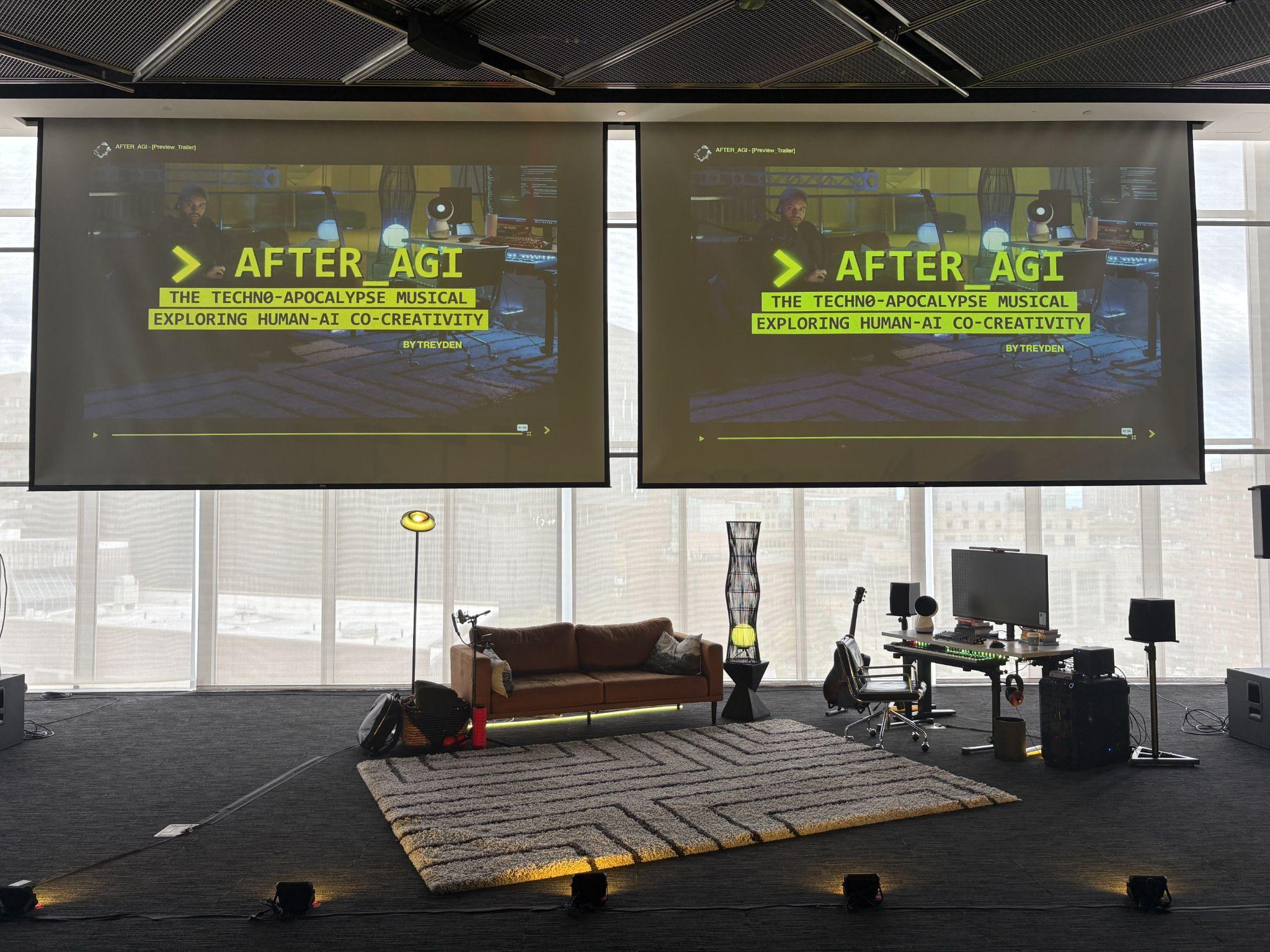
I placed the set between two projection screens, which hung from the ceiling. Three live performance segments were evenly spaced at the beginning, middle, and end of the live 45-minute show. Film clips were shown in between these live sections. A performance lecture titled “Thesis_Intro” opened the show, in which I performed live to a prerecorded track explaining my process of making the musical in a theatrical style. The song "Turing's Rolling In His Grave" was performed in the middle of Act One, and a closing number, titled "Thesis_Outro," was performed live, bookending the event. There isn't a viewable recording of this live event, but you can watch the studio version at afteragi.io.
A majority of Act Two was built, including the script and some filming. But acting, directing, and shooting it yourself is a mind-boggling effort, and to do those jobs simultaneously I had to develop my own rehearsal process.
Working as a One-Person Studio
Directing and filming the work while also acting in it meant I had to rely on still-camera shots. Pressing record on the camera, I would then psych myself up, getting into character before entering the frame. When performing a scene or song, I blocked it out in the set as I imagined it in my head. After several takes, I reviewed the footage, made notes on what worked, and rehearsed it again. I repeated this process for each scene and musical number until I liked each enough to piece them together with the other sections.
Everything was filmed and rehearsed in my studio space on the 4th floor of the Media Lab. I angled my set and placed it in the far corner of the 4th-floor overhang, and positioned my Blackmagic 6K Cinema Camera on the far side of the room. This distance gave me just enough space to capture the bounds of my minimalist SF living room with a 24mm lens.
CLEO added interesting challenges as a supporting character. I didn't want to reprogram the robot's movements every time I edited the script, so during rehearsals I mimed with it as if it were responding. I generated CLEO's dialogue with ElevenLabs, a synthetic voice platform, and built a prerecorded base track of her lines that I could play while blocking a scene. This way I could hear her speak even when she wasn't moving in sync.
I didn't want to have to memorize the script while I made changes, so I also recorded my lines to these base tracks, essentially creating a pre-recorded audio version of the script. My rehearsal process was staging scenes to these pre-recorded tracks to assess the pacing and strength of each number. An example of this is a first rehearsal take of Scene_01/Enjoying Unemployment, shown in the video below. You can see this was done with a still wide shot, where I acted to the script but did not speak the lines live on set. My entire December draft was created like this, a bare-bones skeleton of the story.
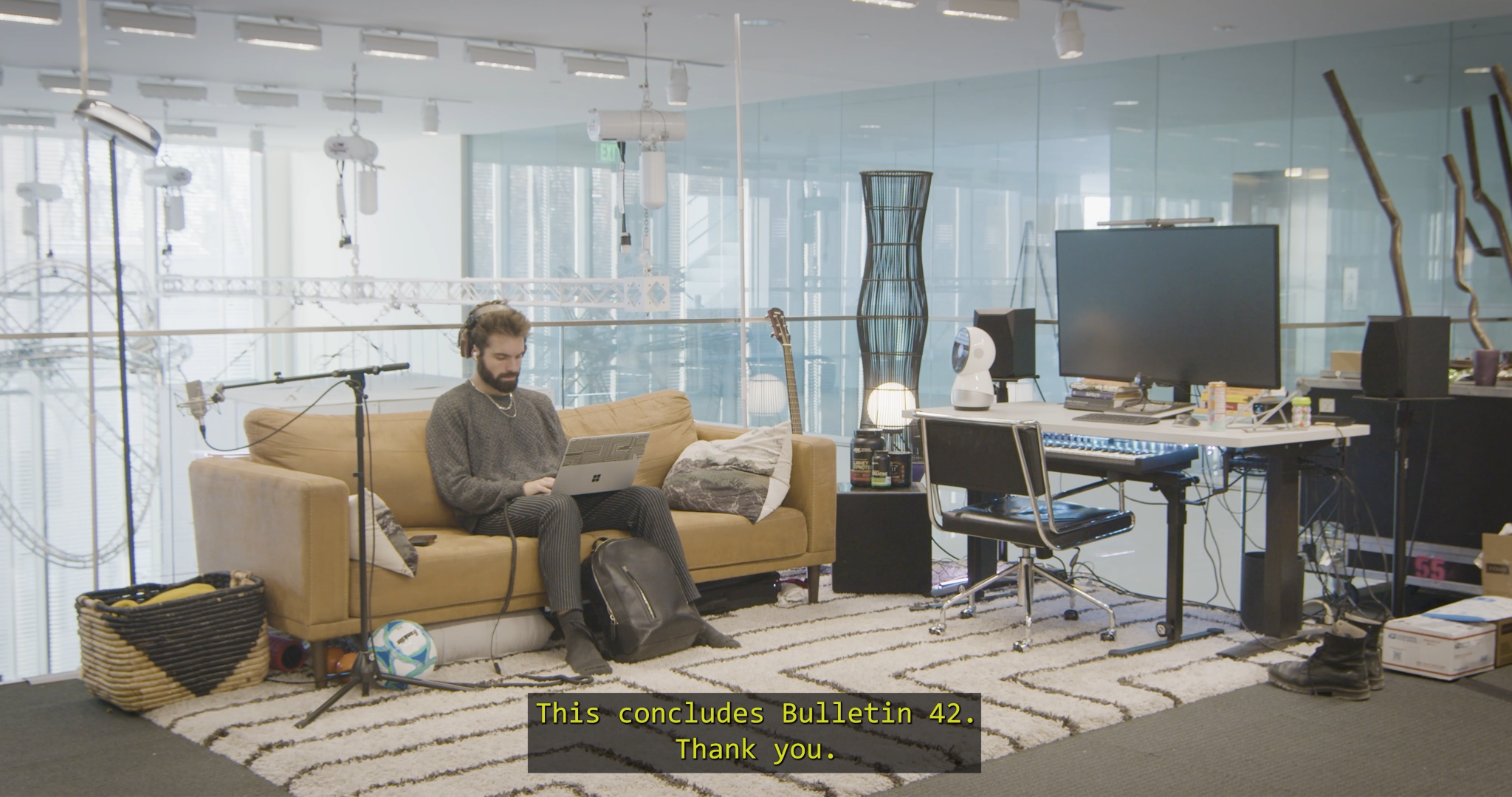
Figure 15 shows the structure of Act One. I broke each act into three kinds of elements — scenes, musical numbers, and voice notes (written as flashbacks) — and Act One comprised thirteen of them in total. With my engineering mindset, I saw each act like a machine broken into individual parts. I imagined songs would lead into scenes connecting like pieces of a puzzle. Each element needed to be a well-crafted piece to carry the story and the aesthetic world forward.
5 scenes, 6 musical numbers, and 2 voice notes made up Act One. Each element was swappable; for example, as mentioned in Chapter 02, I created hundreds of songs. Songs were chosen for Act One and ordered based on their quality and their ability to vary the story's pace. Each song needed enough variation in instrumentation and tempo to maintain intrigue. The scenes went through a similar selection process. Entire scenes, songs, and voice notes were cut from the original script to push the pace. Breaking the entire production into these elements helped me make sense of which needed the most work, and gave me the freedom to remove entire songs and scenes without much hesitation. Altering individual elements always served the higher goal: making one act as strong as it could be.
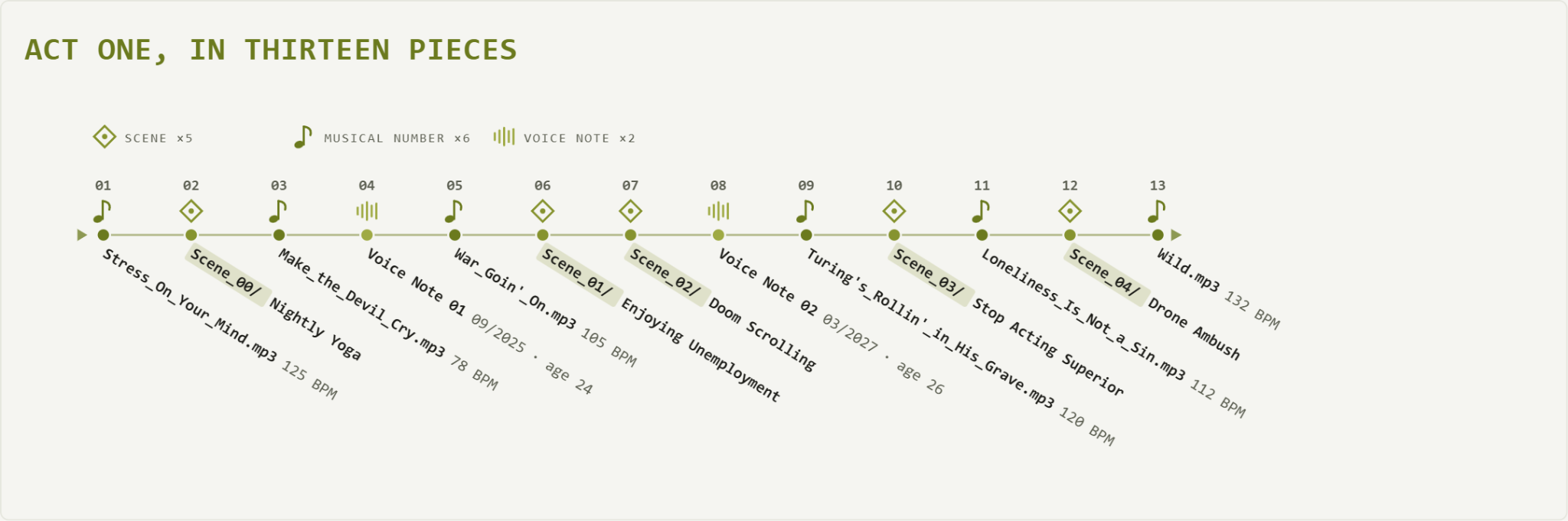
The December_Cut was the first time I shared this musical with anyone. It had a similar structure to the one shown in Figure 15, but many improvements were needed. None of the songs in my first December_Cut made it to the final Thesis_Cut. But most of the scenes stayed the same. Feedback from my peers, along with AI, helped me make significant improvements between these two versions.
To a small group of colleagues, I shared a private link to this skeleton cut via email, providing them with additional instructions. Mainly, I encouraged them to give me honest feedback and not to be afraid to explain what needed correction. Angst gripped me in this moment, along with extreme exhaustion. At this point, I was working 7 days a week for nearly 7 months, often until 3 am.
My rehearsal space was a research lab, crowded with peers, faculty, and MIT staff during the day. So I often used the weekends to shoot scenes once they were sufficiently ready. Or I would wait until night when everyone was gone so I could rehearse in private. It was a lonely process: just me, my computer, and a camera, month after month.
All of my time and effort during this period was consumed by this project. I knew the odds of making this musical feel professional were not in my favor. Having only just started making music and doing all these jobs myself, I was aware I would have many blind spots. I knew I still needed to address many aspects of this December_Cut; it was far from complete. But I needed human insight, if only to keep myself sane.
9: Human-AI Overlapping Signals are Critical
I’m confident you know the weaknesses in your own work, whether you admit them to yourself or not. From my experience working with AI to get feedback, when discussing areas for improvement, these algorithms reflected my opinion back to me. When I got specific in my notes on certain sections of a script, I found that AI changed its opinion on a topic based on how I phrased my line of questioning.
The phrase "stochastic parrots" comes from Emily Bender, Timnit Gebru, Angelina McMillan-Major and Margaret Mitchell, describing how models repeat words back to us without understanding them (Bender et al. 2021). When engaging AI for feedback, this experience of your own thoughts thrown back at you can be quite literal.
When I gave AI a scene I had written to discuss, it would articulate key nuances about the scene, highlighting my points of interest. If I had concerns about whether a plot point felt necessary to the arc or whether a character's dialogue was in the right tone, it would highlight plausible reasons for my concerns. Yet when I changed my mind, it would often change its mind too. I had difficulty trusting that the system had a fundamentally informed perspective on my work. It could push back on my critiques but often in softer ways than humans would.
Human-AI Overlapping Signals are Critical is my next principle for when you're looking for feedback. The first step is to get human eyes on your work. I'd argue this is not optional. Better still, get both human and AI opinions, because the points where they overlap tend to be the critical areas for improvement. Where your friends and peers are great representatives of specific viewpoints, AI can capture a broad, generalized perspective, which can frame what your peers tell you.
Humans and AI tend to diverge on aesthetic choices, the ones with less structural necessity and more subjectivity about what's best. These areas where the best choice is highly subjective are where feedback is tricky. Should you trust your gut instinct? Or listen to the advice of AI or your closest mentor? If both humans and AI say the same thing, it's worth questioning why there is such a dominant perspective. This will only give you a more informed opinion about what you've created and how it will be received.
Hearing feedback, whether from a human or machine, isn’t a final judgment of your work. Feedback is the beginning of letting others into your world. For me, having people understand my perspective and voice is important and a driving factor in why I create anything to begin with. So I try to get feedback often, but I also have my shortcomings. Typically, I want to get everything into a perfect state before I show anyone.
I intend to be courteous to whomever I am asking to spend time with my work, making sure everything is immaculate. But nothing needs to be perfect before you can let someone in. In some ways it defeats the point. I also do this so I can correct all the issues I am aware of before I begin receiving more insight into what to fix next. But it is important to remember upfront: it is incredibly difficult to get people to give you feedback at all! So if someone has the time to spare, take advantage of it. And if anyone in your life is willing to spend time on your work, cherish them because they are key lifelong collaborators.
P10: Use both Coordinate-Based & Coordinate-Less AI Feedback
People are busy. And if they are willing to help you by looking at your work, most only have small blocks of time available. This is why AI becomes an incredibly useful alternative. Use both Coordinate-Based & Coordinate-Less AI feedback is a principle for learning the best practices in prompt engineering for AI feedback. Specifically, I suggest you use two prompting methods when sourcing feedback from AI to get a range of responses when assessing your work.
I use the term "coordinate-based feedback" to refer to what is also called "n-shot prompting". In n-shot prompting, n is the number of examples you provide to a model before asking it to do a task. In terms of feedback, I found that providing a reference to a work you admire is like giving AI coordinates to help it orient its understanding of what you're after. Most often, I would use just one or two examples or coordinates when using AI to compare them to my own creations.
For example, when getting feedback on a scene, I could take a scene from Phoebe Waller-Bridge's Fleabag or from the musical Hamilton references mentioned earlier. Then I would ask AI to explain how my work differs structurally from these sources. If these “coordinate” sources differ drastically, you get a sense of how your work may position itself between them to claim a unique style from your references. Basic structural differences such as sentence length, structure, or common vocabulary can become apparent with this method. The goal isn’t to emulate your source material but to give you greater awareness of your habits and areas for improvement, based on these works you hold to a high standard.
A coordinate-less version, in scriptwriting, would sound like “My CLEO character sounds too sad in this scene, and it isn’t warranted. Do you also think so?” This method intentionally avoids providing references and uses purposefully indirect language when formulating your question. I used this tactic less often in scriptwriting, since I often found its responses to feel artificial. But I used this method often in UX/Design and other fields where I trusted its general knowledge. One tactic for coordinate-less feedback is to give AI guidance on best practices in a field, such as UX/UI design guidelines. After providing this as a separate document, you could then ask AI, “My home file on Afteragi.io is not formatted properly for mobile devices. What needs to be addressed based on our best practices guidelines?”
Often, when providing a reference or a coordinate to AI, it can be overly oriented toward that source. This coordinate-less approach intentionally avoids giving AI examples, allowing the model to use its general domain knowledge and apply it to your unique style. AI has ingested most widely known source material so that it can give you generalized advice. Often, this generalized advice is a good enough jumping-off point to help you identify either what you need to learn more about or the direction of the changes you need to make.
Feedback is not the final solution to your problems! Feedback is most often just the entry point to bring your work into its next, ideally elevated state. You might know now what you want to fix based on feedback, but you have to fix it. And the answer you discover can be different from what you came up with in the feedback phase. This is ok. What is important is that this feedback process sets you on the right path. Putting as much effort as possible into fixing the critical elements at each phase will make your work improve rapidly! This is why great feedback is so precious.
Why didn’t I use Generative Video?
Generative videos make up a vast amount of “slop” on our media feeds today. I originally intended to use generative video models to create complementary animated visuals for my musical numbers in After AGI. However, when testing ideas for using AI in this way, I encountered the persistent challenge of ensuring consistency across multiple video clips. Characters, or key elements, always looked slightly different from shot to shot. A year later, it is still difficult to generate consistency across multiple video clips, which is one reason why I didn't use them in this work.
Improvements are coming, but After AGI was primarily a live-action production, and integrating animated elements felt forced. When I experimented with generative video as a background for the musical numbers, it didn't amplify the worldbuilding; it added information that pulled you out of the story. A mix between an animated world and live-action footage is a hard bridge to build. Between the December_Cut and Thesis_Cut, I had around 3 months to make changes. As I refilmed the updated script and songs based on the feedback, this addition fell out of scope in my timeline.
For now, the live-action shots felt sufficient for the world-building, and cutting between multiple recordings of me dancing gave the film enough dynamics to hold the story. If I continue to develop this musical for future performances, I intend to keep experimenting with incorporating generative video models. I have been curating my own visual datasets to explore how to integrate them into this work.
My objection isn't to generative video as such. It's to models trained on other people's work without their consent. My plan is either to collaborate with a visual artist to work inside a visual language whose author has permitted me or to train on my own datasets, grounding the visual world in material I actually made. Both align better with my values and my taste.