Human-AI Co-Creative Practice: Framework & Principles
More than Instagram, more than YouTube, more than email, every day I am glued to a chat thread. Morning, afternoon, and night, I have three or four conversations running at once. This is how I work now. But I am not alone. Nearly one in four Americans now talks to an AI every day (Gottfried et al. 2026). Most of us are uneasy about it. The same Pew Research survey finds more people expect AI to make life worse than better. I'm worried about it too! If you can't start your workday, plan your week, or finish a creative project without talking to an AI, you are one of us. But is this a trap? After AGI is my fight for hope amidst this tremendous uncertainty.
Over the past year, I've recorded my daily interactions with AI to understand methods for collaborating with intelligent systems to enhance the creativity of humans and machines. Drawing on three projects: After AGI: The Techno Apocalypse Musical (the script, score, and film), the AfterAGI.io web app, and the Hacking the Subway public installation and data music video, I've developed the Co-Creative Loops Framework and 13 Principles for Human-AI Co-Creativity. Both are designed to be used immediately, helping you keep your sense of purpose intact while working alongside these systems.
As of 2026, AI is history's fastest-adopted technology (Bick et al. 2024), so most of you reading this have already used it. If you are against using AI, I hope this work helps you see how you might use it to your advantage while remaining critical of its issues. If you are an AI “power-user,” I hope these principles inspire you to use AI with a newfound scaffolding to enhance your creativity. The framework is meant to help people manage multiple jobs and the increasing pace of co-creative work. Its principles provide guidelines for limiting the negative impacts of AI in creative work and for maintaining a sense of authorship when using these tools.
You probably already have strong opinions on whether AI is good or bad, creative or not, and hopefully you can suspend these judgments while engaging with this work. Regardless of your opinion, there are AI tools for creating music, writing scripts, filmmaking, graphic design, game design, podcasting, and even acting and dance. Some believe AI can do just about every job better than a human. But I promise you it's not that simple.
Co-Creativity Loops Framework
The Co-Creative Loops Framework is a way to see how you are collaborating with AI, and, more importantly, to decide where you want AI involved in the first place. It breaks a project down into the individual jobs required to finish it. Each job you share with AI becomes its own Co-Creative Loop: a cycle of generation, feedback, and iteration that you and the machine run together. For each loop, you set a goal for how much of that work you want AI to do. I introduce the framework briefly here so you can follow where AI entered my process described in the chapters to come.
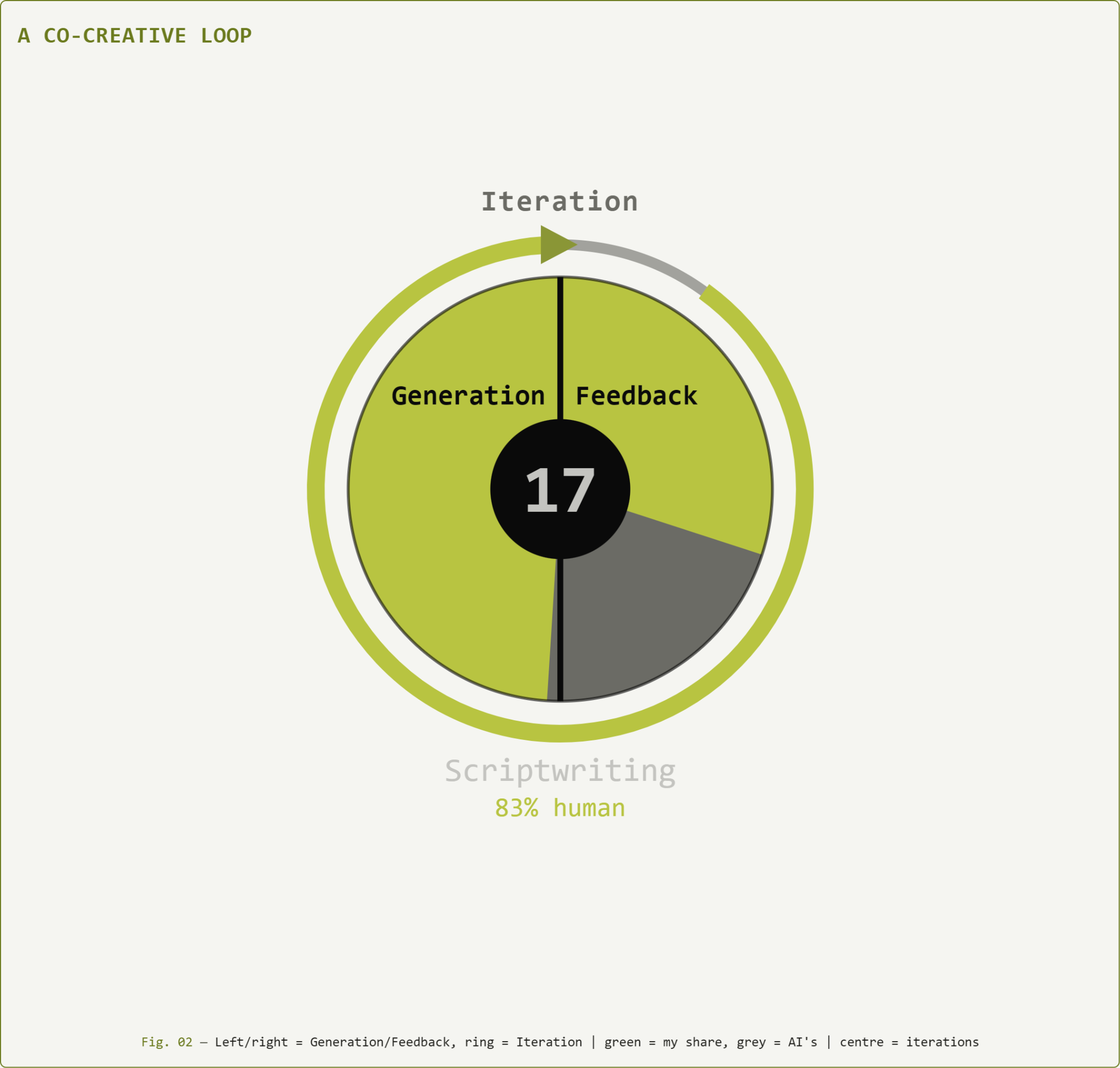
Figure 1 shows a single Co-Creative Loop, broken into three phases: Generation, Feedback, and Iteration. Each phase carries a number: the share of that work that was mine rather than the machine's. Scriptwriting on the musical came out at 95% human generation, 60% human feedback, and 90% human iteration. I wrote almost all of it myself and revised almost all of it myself, but I let AI take its largest role in judging what I had written. These are my own estimates rather than measurements, and Chapter 06 explains how I arrived at them. You can find an interactive version of this to build your own loop on my thesis book site at www.book.afteragi.io
The visualization encodes three things. A loop’s size comes from the averaged ratios: the bigger the loop, the more of the work was mine. Color carries the same signal: the more green, the more human. A Co-Creative Loop's speed reflects how many times a job's output is iterated upon during your project's timeline, which in my case ran about a year. Trends for how much I used AI across loops and where I found it most useful will be discussed in Chapter 06.
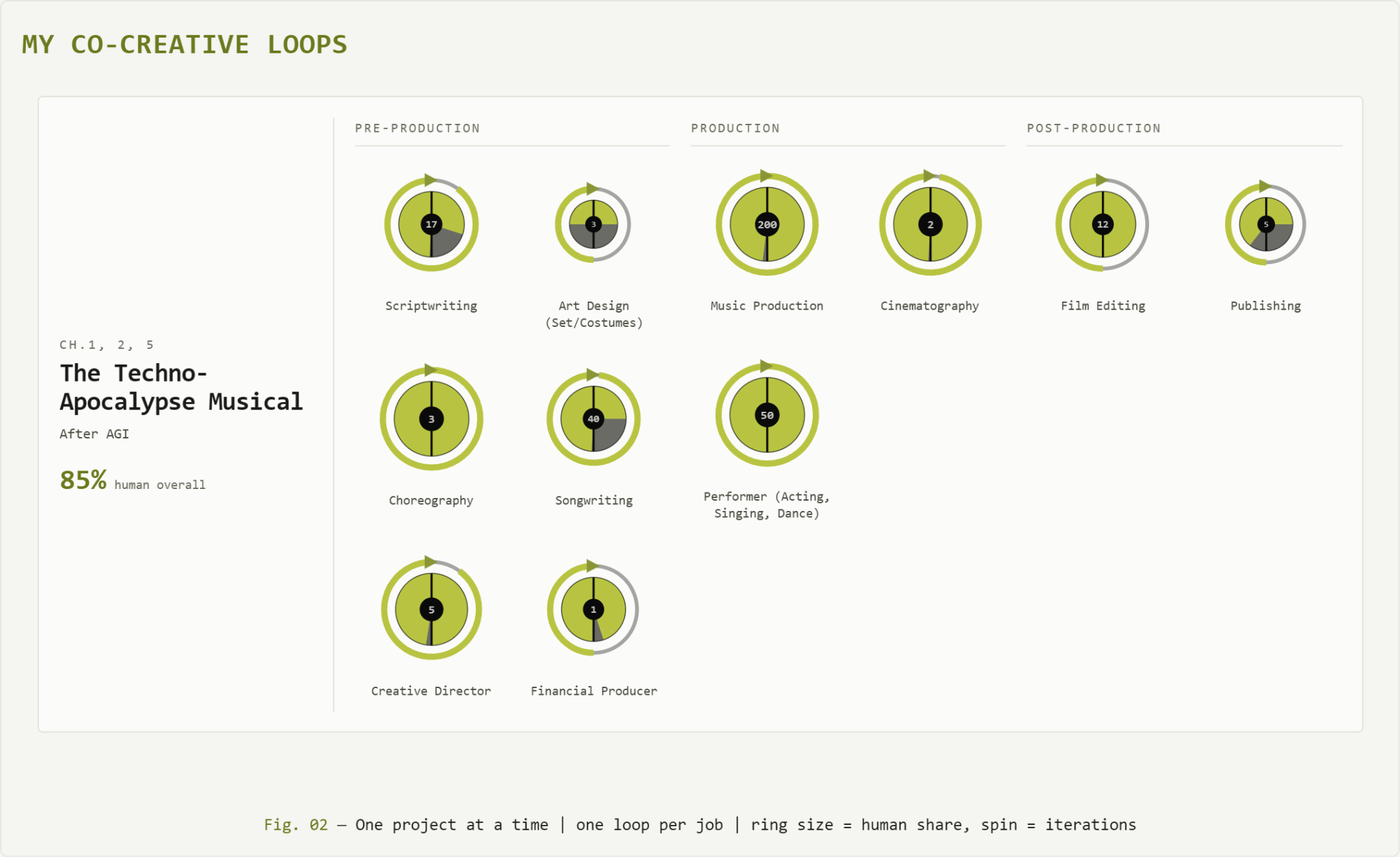
Each loop corresponds to one job within a project. A project with multiple jobs therefore has multiple loops, as shown in Figure 2. The musical is visualized with 11 loops for 11 jobs, split into three stages for easier reading: pre-production, production, and post-production. Depending on your project, you can include jobs I don't mention here, such as finance or legal.
Breakdown of the 3 Phases: Generation, Feedback, and Iteration
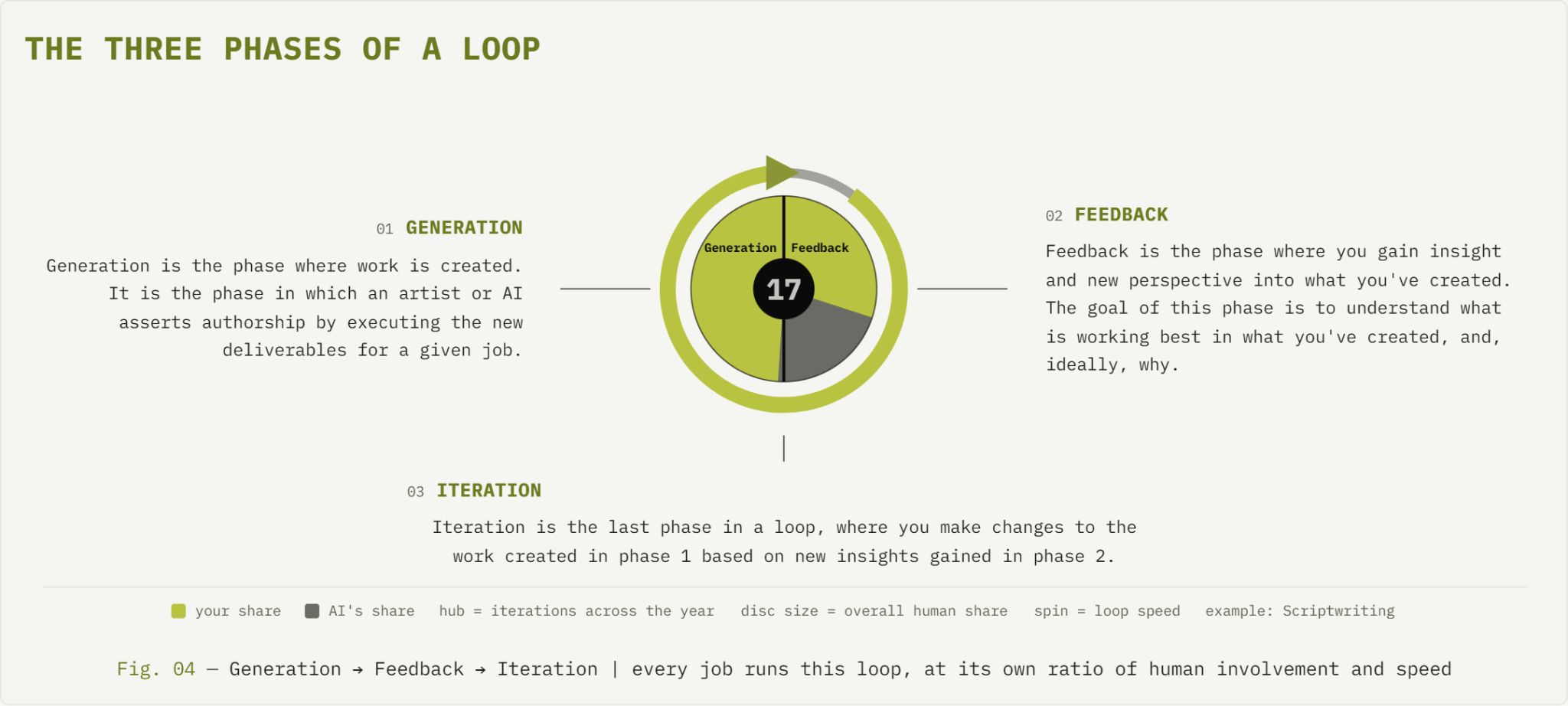
All three phases are in each of the 11 co-creative loops shown in Figure 3. Generation is where work is created, including the initial ideas, what people often call ideating. It begins every job, though it looks different from one to the next: in publishing I began by creating a publishing plan, whereas in dance I began by developing a movement prompt to improvise with. Generation can include discovery and inspiration, and I don't intend to imply that it emerges from a void. Both algorithms and humans draw on work that already exists. What distinguishes this phase is that an artist or an AI asserts authorship by executing the new deliverables for a given job.
The generation phase goes wrong most often when you co-create with AI in a field where it has more knowledge and skill than you do. That can produce a false sense of confidence about what you actually know, a habit of reaching for AI-generated work before making your own, and eventually a dependence on AI to execute tasks you cannot. The concern most people share is that AI will think for us. Working in this phase, I found that a commitment to personal growth and a conviction about what was most meaningful for me to contribute were what counteracted those impulses. The principles I discuss later will also help counter these impulses.
Feedback is where you gain insight and perspective on what you've created. The goal of this phase is to understand what is working best in what you've created, and, ideally, why. Getting this type of perspective doesn’t require technology at all. Sometimes just time away from what you’ve generated is enough to reengage with your work, seeing it with fresher, less biased eyes. Sometimes what you like or dislike is immediate the moment you see it. This could be due to the gulf of execution (“Direct Manipulation Interfaces: Human–Computer Interaction: Vol 1, No 4” 1985); you weren't able to achieve what you set out to do. What you decide is working best might not even be what you set out to make when you started generating. Once you've stepped back, what needs to change might be evident, and you move directly into iteration.
The problem in this phase is that we are rarely good judges of our own work. We can either be hypercritical, discouraging ourselves from continuing, or wear rose-tinted glasses, giving ourselves unworthy praise. That is why we seek feedback from other people, or from AI. In doing so, we can find ourselves either relying too heavily on their suggestions, causing us to diverge from our original intent, or becoming defensive and dismissing useful data about our work. There are quieter failures too: not asking for feedback frequently enough, neglecting human perspectives in favor of AI alone, or not giving enough clarity in your instructions for anyone, human or machine, to surface the insight you actually want.
Iteration is the last phase in a loop, where you change the work you generated based on the insight you gained. It also includes planning what still needs to be made, delegated to another job, or cut to move the work toward the finish line. The number of iterations a job requires varies enormously. In the music production of After AGI, I roughly estimate 200 iterations over the year, compared with scriptwriting, which had 17 official versions. Iteration count can serve as a proxy for how much time a job consumes, but it deceives as easily as it informs, because it is tied to the size of the deliverable. Although the script ended at iteration 17, it could take a week to get from one version to the next, whereas in music, I could iterate on one song per day.
A unique problem as AI is introduced into this iteration phase is that we now make things too quickly. The result is “slop,” mass-produced AI-generated digital content, and a method of making that erodes your sense of ownership over what you’ve created. The speed is also its own trap. We get lost in rapid iteration, even addicted to it. Completing tasks quickly feels like accomplishment, and that feeling can crowd out the larger question of what you meant to make in the first place.
For each problem discussed in each phase here, the following principles are intended to help you consciously navigate these problems. But be aware that creative processes are inherently messy, chaotic, and emotional. I am not offering a way to avoid mistakes, or a way to make co-creation easy. As I discuss later, mistakes, personal growth, and your own vulnerability are vital to making good work. But these principles are scaffolding to help you recognize what you're going through in your own co-creative projects, and to see how you might change your approach.
13 Principles for Human-AI Co-Creativity
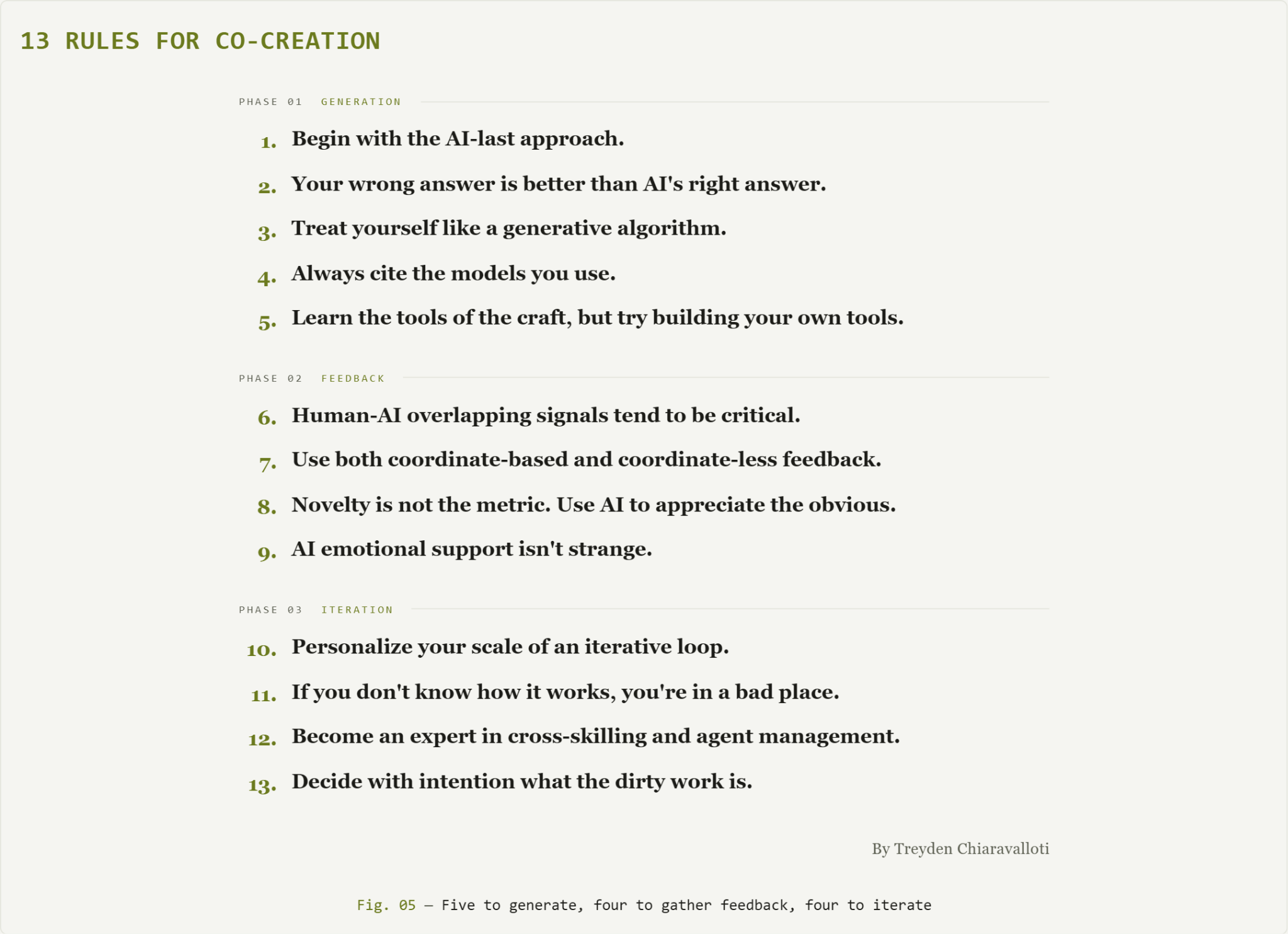
Figure 4 shows all 13 Co-Creativity Principles, and I introduce two to three in each of the coming chapters using direct examples from the project each chapter covers. They are rules of thumb for guiding your engagement with AI in each phase of a co-creative loop. But these are not hard rules, and I encourage you to break them when you have good reason to.
I've split the principles into the 3 phases discussed earlier, with 4-5 rules per phase. This was done to provide more direct guidance on how each principle might be applied in your workflow, specifically addressing the problems of each phase. The boundaries are soft: Always Cite the Models You Use is listed under generation but matters just as much in feedback, if you're using different tools to critique than to create. The same is true of how each is used for different jobs. I introduce the Begin with the AI Last Approach through scriptwriting in Chapter 01, but it applies equally to music, code, or finance.
A.I. Creativity Frameworks
To clarify how my contribution fits alongside existing work, here is a brief overview of AI creativity frameworks, which fall roughly into three categories: general guidance for individuals working with AI, academic models of how co-creative systems should be built based on user studies, and older pre-LLM foundational work on the roles computers might play as creative partners.
In the first category, Anthropic's AI Fluency framework (“AI Fluency” n.d.) is the most similar to what I propose. It offers a broad-strokes view of the three modes in which we work with AI: automation, where AI executes our specific instructions; augmentation, where human and AI collaborate as thinking partners; and agency, where AI is configured to work independently on our behalf. It pairs those modes with four competencies — Delegation, Description, Discernment, and Diligence — intended to apply across domains. Anthropic released it in 2025, months into this project, so my framework and principles developed alongside it rather than from it.
Ethan Mollick's Co-Intelligence (Mollick 2024) takes a similar practitioner-level view, proposing rules of thumb such as "always invite AI to the table" and "be the human in the loop." Mollick distinguishes "centaur" work, where tasks divide cleanly between human and machine, from "cyborg" work, where the two interweave at every step. I propose a guideline for how AI fits into each co-creative loop, with specific examples for each phase.
The academic literature approaches the question from the system side. Wu et al. (Wu et al. 2021) introduce the concept of "AI Creativity" and a corresponding Human-AI Co-Creation Model, based on a study of over 1,600 application cases spanning 45 fields. Their model argues that we should collaborate with AI rather than compete with it, and maps out the new possibilities AI brings to the creative process. I agree with their emphasis on collaborative work and don't compare human-generated work against AI-generated work; rather, every job on a project with the Co-Creative Loops Framework can have some ratio of Human-AI collaboration.
Kantosalo et al. (Kantosalo et al. 2020) categorize human-computer collaboration by its modalities, styles, and strategies. Relatedly, Rezwana and Maher's Co-Creative Framework for Interaction design (Rezwana and Maher 2023) models the interaction dynamics of co-creative systems: turn-taking, contribution type, and communication. Both contribute strong analyses of co-creative systems and map how we interact with computers in creative work across people and fields.
The oldest of these predates modern LLMs entirely. Lubart (Lubart 2005) proposed four roles a computer might play in creative work — nanny, pen pal, coach, and colleague — written before large language models made any of them plausible. I never assigned my models a role via system prompts within a Co-Creative Loop. However, I recognize that assigning AI a character can be a useful prompt-engineering tactic for improving responses.
What I present here is not a taxonomy of interaction types, a workplace fluency curriculum, or a user study of how people across fields use AI. It is a framework developed from my own experience using AI productively and purposefully across multi-domain artistic projects. Co-Intelligence and the AI Fluency framework describe work in general; I address creative work specifically, and the stakes of authorship that artists face.
I don't distinguish between automation, augmentation, and agency. I assume each is possible within a Co-Creative Loop, which represents a single job you're collaborating on with AI. And instead of proposing competencies, I break each loop into three phases — Generation, Feedback, and Iteration — with guiding principles for each that should map directly onto your process.
This is closer to a working artist's rulebook, tested against finished work. The framework and its principles will be most useful to individuals and small teams on large creative projects, and to people working across multiple fields at once. I hope it gives you direct insight into my co-creative process, and helps you decide how you want to use AI in your own.