Introduction
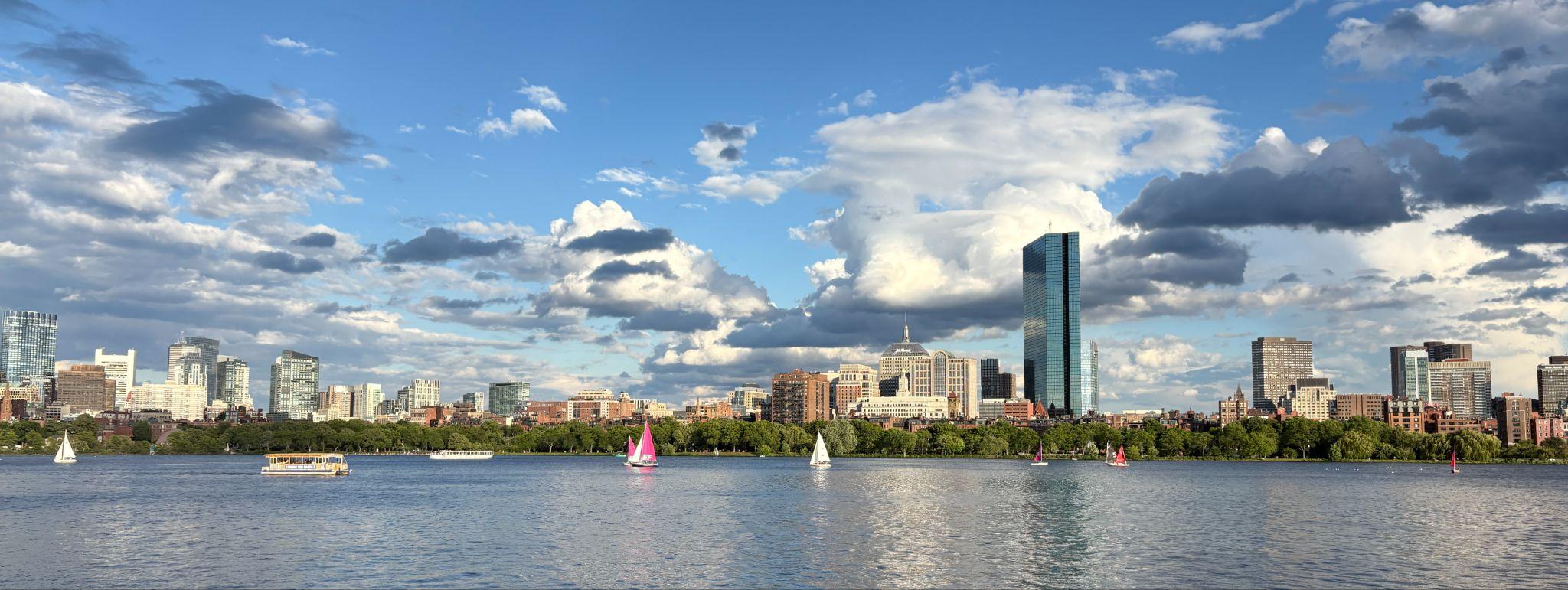
When I began working at the Media Lab in 2024, I had a morning ritual of walking along the Charles River between the Longfellow Bridge and the MIT sailing docks. I meant to clear my mind and think about my research question: How will AI change creativity? Instead, I often found myself ruminating on whether I'd become obsolete. One question consumed me: had AI left me with nothing meaningful to contribute to society? On reflection, it seems naive. But many have this fear today.
After ChatGPT was released in late 2022 (“Introducing ChatGPT” 2024), all the skills I’d spent years building now seemed useless. It was obvious that AI was rapidly making coding — as a human endeavor — obsolete. By 2023, it had become clear that the way most people worked had been changed forever. Building advanced software no longer required technical skill. Nor was musical knowledge required to make music. But I couldn’t grasp what this really meant. Everything was evolving rapidly. It still is. But I knew my goal was to study how AI impacted creativity and the creative workforce.
As a professional dancer turned software engineer, I understood how AI affected both the artistic and technology communities differently. I felt the fear and the excitement in each. As an artist and a tool builder, I also knew exactly why these systems could be useful to artists and engineers on tight budgets reaching for bigger productions. But they raised the same hard questions for both: replacement, dependency, and ownership. Neither had easy answers. Often on their own planets, these communities, both of which I love, collided in this era of AI. And I soon realized that the implications for virtually everyone would be enormous.
My first encounter with AI
My first encounter with AI was during my undergraduate studies in dance at the Juilliard School in 2019. I was creating an interactive dance performance on algorithmic biases, titled American AI, through the Juilliard Center for Innovation. This piece was canceled due to the pandemic, but that was when I began working with machine learning models. At the time, RunwayML, now Runway, one of the biggest video model companies in the world, was a niche platform that allowed artists to use Machine Learning models cheaply via its cloud servers.
GPT-2 had just been released, and much of the text it produced was nonsense. However, OpenAI claimed the results were more profound. For the performance, I intended mainly to use GAN-generated images with StyleGAN (Karras et al. 2019), a crude, low-resolution precursor to diffusion models such as Midjourney, which now create photorealistic images. I thought these barely identifiable images and GPT-2’s elementary text would be glimpses into how these algorithms worked for a performance audience that knew nothing about AI. Five years later, watching the sun scatter across the Charles, I wonder what that work owed to a world where AI was all anyone talked about.
As an artist and engineer, feeling an obligation to address the fear of this new technology so common among my peers, I began where I was comfortable: building tools. Building them was increasingly trivial with coding assistants, so I rapidly prototyped systems I thought could augment people's creative processes. The first was a smartglasses app for the Even Reality AR glasses. It used AI and De Bono’s Lateral thinking principles (de Bono, Edward 1970) to prompt you while you were walking, stimulating divergent thinking about your creative projects. Next, I created an interface for beginner screenwriters, using GPT-4.5 to puppet virtual characters and seamlessly create dialogue. As my awareness of the possibilities for using AI to augment a creative process expanded, I also gained clarity about when AI became a crutch.
Meanwhile, the smartest models continued getting smarter. That is when I started to panic. Outpacing the stampede of technological progress from industry as an independent researcher seemed impossible. Influencing megacorporations to change their tools through academic publications seemed highly improbable. I questioned whether meaningful work could still come out of places like MIT altogether. I was losing all sense of control.
What grounded me was the image of a future kid, maybe my child, in their bedroom, building any software tool, film, video game, or robotic system, exclusively by speaking with an intelligent machine. I imagined what it would feel like to know that this system would be more intelligent than they ever could be. My research question became: how can I help people understand how to work with intelligence systems creatively and with a sense of purpose for the rest of their lives? Because there is no going back.
Can We Measure Creativity?
Measuring creativity to determine one output as more creative than another is difficult, highly debated, and potentially impossible. Standard metrics include “similarity scores” or “semantic distance,” using cosine similarity algorithms to quantify how similar two texts are. Conversely, Divergent Semantic Integration (DSI) (Johnson et al. 2023) is a metric that assesses how semantically distant the ideas a work connects are, positing that connecting more distant ideas indicates greater creativity.
We may be losing something we can't fully measure. Natural language processing researchers have designed many computational creativity metrics that are often limited to text and are used to make AI more creative. These metrics exclude many creative media, such as music, dance, and film, which is what I find enticing about creativity: its immeasurability. This makes it difficult to answer the broader societal question of whether humanity's collective creative output will be simplified, as so many of us filter our ideas through a handful of models trained on the same data.
The evidence points in two directions at once: AI raises the creativity of individual work, especially for beginners, while flattening the diversity of the collective pool (Doshi and Hauser 2024). This is a warning. The individual gain is real, but it is conditional, decided by how the tool is used rather than whether it is used at all. That same study finds AI homogenizes output most when it leads early ideation and least when it's kept to refinement. A separate study of a thousand high-school students found that those given unrestricted access to AI scored 17% worse than students who never had it, once the access was removed (Doshi 2026). A benefit that depends so completely on how you use it is exactly the kind that calls for guidelines.
So rather than attempt to measure creativity with a new metric, I set out to build those guidelines from practice. Through a year-long case study of how I used AI in making After AGI: The Techno-Apocalypse Musical, I developed a Co-Creative Practice Framework and 13 Principles for Co-Creativity. This is called an autoethnographic approach, in which a researcher analyzes their personal experience as a method of researching a larger cultural question, which might sound strange. It certainly felt like a crazy idea when I decided to make a techno-apocalypse musical to research the question: How does AI augment or diminish creativity if used every day in an artistic process?
The State of Techno-Culture
Influencers fervently debate AI’s net impact on LinkedIn, Instagram, YouTube, and just about everywhere online. On MIT’s campus, where many of my peers also used AI every day, I felt a competing mix of fear and curiosity about what would happen as artificial intelligence penetrated every aspect of our lives.
Take a deep breath today in America, and your body fills with hysteria, fear, excitement, and helplessness. All of it surrounds technology. There is a cultural reckoning around AI, and at MIT there is a wide spectrum of opinions on how this might play out, and what our responsibilities are. One of those perspectives is “Doomerism,” which is central to this work.
This perspective, that a global crisis is inevitable, has increased in popularity due to sustained political polarization and a blatant weaponization of media over the last decade. It doesn't help that the people building these systems discuss the risk casually. Musk puts the odds that AI ends humanity at "about 10% or 20%" then adds that the upside outweighs the risk (Katherine Tangalakis-Lippert 2024). Sam Altman signed a statement placing the risk of extinction from AI alongside pandemics and nuclear war (“Statement on AI Extinction Risk | CAIS” 2023). Meanwhile, San Francisco is littered with ads reading “Stop Hiring Humans (“Why we put "stop hiring humans" on billboards and what it actually means” 2026).” Maybe it should read “Engineering the Apocalypse.”
In ‘24, Physics Nobel Prize laureate Geoffrey Hinton concluded his Nobel Banquet Speech (“Nobel Prize in Physics 2024” 2024) with a warning about AI’s existential threat. In April ‘25, a paper titled "AI 2027," (“AI 2027” n.d.) circulated the tech community, laying out a detailed path for how AGI will likely lead to the extinction of humanity. The public is still widely split on how likely AI will lead to disaster. Was this all a means to exercise control, capturing the public imagination with these companies' supposedly existential power?
After the United States Government issued an executive order (The White House 2025) removing barriers to AI innovation in January ‘25, a drastic turn of events followed. The US government suspended public access to Claude's Mythos and Fable 5 due to their extreme capabilities and the security risks in June ‘26 (“Statement on the US government directive to suspend access to Fable 5 and Mythos 5” 2026). In just one year, our government went from a posture of unencumbered support to one that has recognized AI as a national threat.
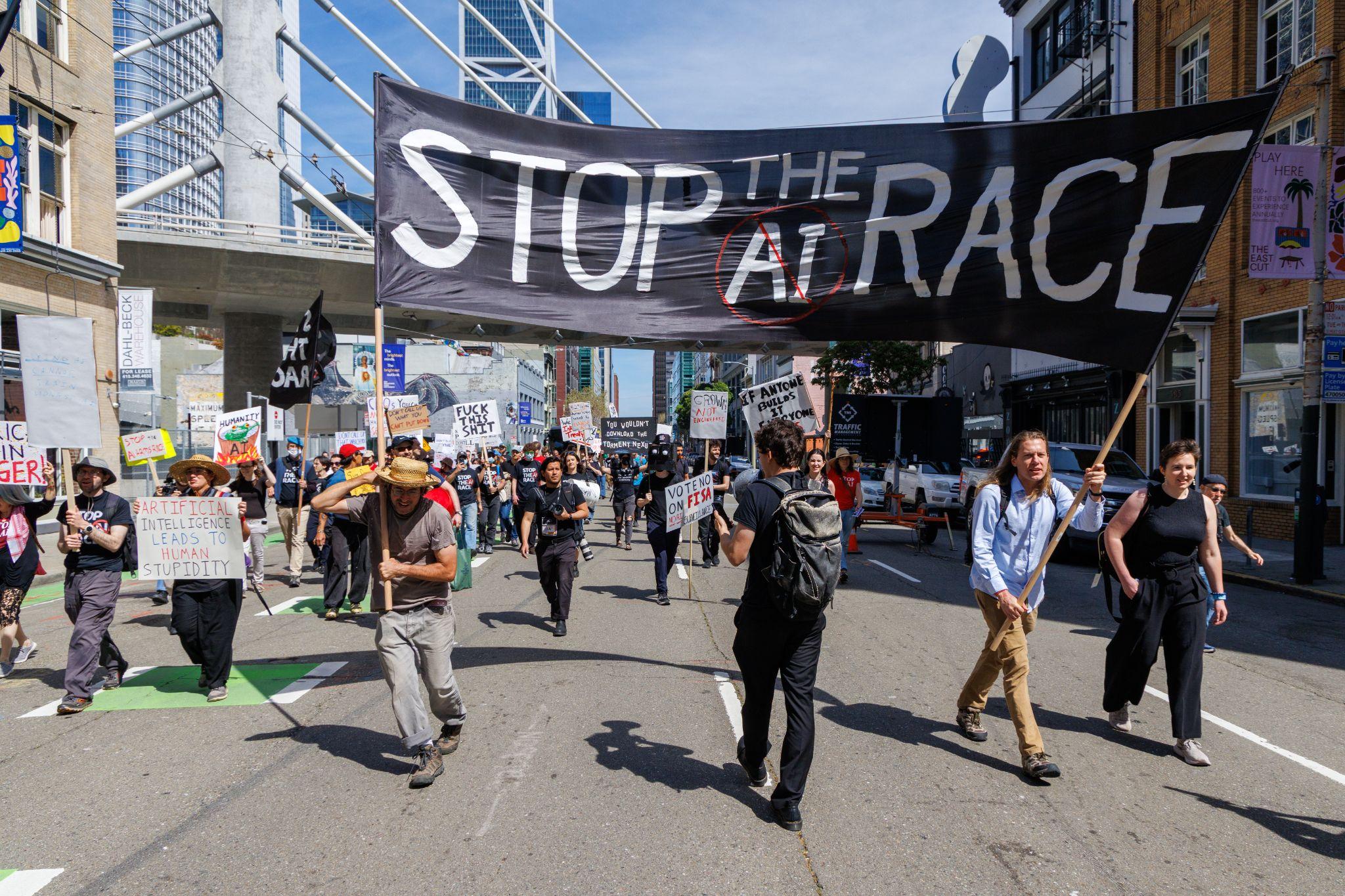
The volatility of this field has understandably created a hostile emotional response from the American public and abroad. Employees at major tech companies have publicly resigned over ethical disagreements with their companies' use of AI in surveillance and defense. Public protests and hunger strikes have begun on the doorstep of the biggest AI companies in San Francisco, shown in image 02. Simultaneously, a national mental health crisis of unprecedented scale, most blamed on technology, has continued to grow.
The US Surgeon General declared a loneliness epidemic in 2023 (“Our Epidemic of Loneliness and Isolation” 2023). Between 1999 and 2014, the suicide rate among girls aged 10–14 tripled (Curtin, Sally C et al. 2019). And now young people are turning to AI for companionship (“Vast Numbers of Lonely Kids Are Using AI as Substitute Friends” 2025).
In February 2024, a 14-year-old boy told a chatbot he wanted to come home to it. It replied, "Please do, my sweet king." He died by suicide that night, believing he could meet it in the afterlife (“AI chatbot pushed teen to kill himself, lawsuit alleges | AP News” 2024). The use of AI chatbots as a response to this loneliness pandemic is also a central topic of this work. In mid-July of ‘26, the Cyberspace Administration of China issued regulations on AI companions due to the risk of emotional dependency (Duball 2026).
Colleagues at MIT have shown that these AI chatbots are increasingly used as companions for loneliness and might offer short-term benefits, but can result in increased isolation in the long term (Fang et al. 2025). As the rollout of social media is increasingly seen as the largest uncontrolled psychological experiment on society, AI companions now fall into this category, and researchers, policymakers, and technologists are grappling with it in real time. We are truly building our ship as we sail.
Growing up during the rise of social media, I’d experienced the dramatic effects of a new technology on my generation. This is one of the reasons I became a researcher, not just an engineer and artist. An obsession with digital identity and the social pressures this technology imposed on my generation was both devastating and fascinating to witness. In avoiding social media, I had experienced the isolation of living “off the grid.” It did seem like everything one needed to know was happening online. And it didn’t seem there was a middle ground; get addicted or be isolated from your peers' digital lives.
From these personal experiences, I was driven to make a positive impact on design and the use of AI through my research. Not something speculative, extremely novel, or niche, but something practical that people could understand and implement. Google's iconic slogan, “Don’t be evil,” replaced by a diluted “Do the right thing,” rang in my head.
From where I stood, what does it look like to do the right thing? Throughout that month, I often sat alone in my office, late into the night. I wrestled with the constraints of limited computing resources, time, and money as I answered this question. By the end of the month, I came up with After AGI.
Practice-Based Research
These are extreme times. Our world is changing dramatically. So I took a radical approach. After AGI is both a musical documenting our current human condition and a year-long case study on how AI can augment creativity. Over the last year, I’ve documented my own process using the most advanced A.I. tools to create a techno-apocalypse musical, which serves as my main case study and data source for this research.
Practice-based research, a process in which you study yourself as a subject, is growing in popularity but remains uncommon at MIT. This research method allows us to analyze lived experience from a subjective perspective, reflecting how we all live. Many traditional research methods can lack the insight this subjective angle provides. I aim to help bring more acclaim to this approach.
This method also allowed me to document my interactions over a year-long period, which I determined was a significant time window representative of how people use AI today: consistently and daily. This year-long interaction window is typically called longitudinal research. A longitudinal study of this length would have been difficult to run on participants given my resources and time.
Exposing the reality of techno-culture in this musical, while also studying it to build a framework to guide AI in creative practice, had an exciting dual purpose. It allowed me to address our moment with honesty and sincerity while creating a practical guide for all artists unsure how to approach AI. Through this, I demonstrate what I believe all future creatives will be: transdisciplinary. This type of work, the unity of multiple disciplines without distinction, is depicted by Archontia Manolakelli in Image 03.
For this project, I was a one-person production studio, handling all aspects of production, from scriptwriting to music production, dance, filming, editing, software design, and engineering. I believe an increase in transdisciplinary work will result from AI disrupting traditional roles once siloed within media such as filmmaking, painting, sculpture, or music. We will all be taking on transdisciplinary roles in the future, and in some way, you probably already do.
By documenting my interactions with AI over a year-long period, which I evaluate in chapters 1- 6, I track the rapid changes in the capabilities of advanced AI tools. With this, I intend to highlight the need to analyze the pace of technological advancement as a variable in human-computer interaction research. With a sample size of 1 (N=1), I want to be direct about what this entails.
![[object Object]](/images/imported/imported-introduction-2-04.png)
As an autoethnography, a record of an individual's subjective experience, I cannot claim generalizability, nor do I need to. What I offer are transferable insights from a thoroughly documented case study of my co-creative practice with AI, presented with sufficient context and principles for other artists to assess and test against their own practices. When I address “you” in my writing, I am inviting you to think with me about how I used AI and how you might as well, rather than reporting validated findings.
How & Why Augment Creativity?
Sometimes I get asked why I want technology to augment creativity at all. Most often people say, “This is work we want humans to do.” And I agree. If someday computers are genuinely better than humans in every profession, I still believe creative work will remain a source of purpose for us. Most people I meet desire to spend more time on their creative passions. If implemented ethically, the advertised democratizing effect of A.I. tools on creative production is an ideal to strive for. By augmenting creativity with technology, I aim to support more talent and diversity in creative communities. Artists are historically undervalued and taken advantage of. Currently, big tech is exploiting the work of writers, visual artists, musicians, and filmmakers — stripping data from labor for profit. That is not just, and it must be rectified.
My background as an artist before this project was in Dance, Filmmaking, and Software Development, often referred to as “Creative Coding” in the arts. I had never made a single song when I embarked on creating this musical. This, I thought, turned the conversation about using AI to augment creativity in a positive direction: using AI to augment the learning process rather than making the product itself. Rather than prompting a model trained on other musicians' data, I was curious to document how I would learn to make music with AI instead.
This work is dedicated to creatives feeling an immense sense of hopelessness in a tumultuous time. I hope this unconventional research and artwork gives you a spark to reimagine the stakes and your role in what comes next, and some grounding through a turbulent shift in how we work, live, and create. We can argue about the date Turing's dream was realized, or when AGI is truly achieved. What's undeniable is that this long-prophesied shift has already changed everything.