Making a Musical: The Story & World
When I was 18, I wrote my first full-length script. It was so embarrassing I never showed it to anyone. The problem was that I didn't know what it was about. I couldn't figure out what the main character wanted, or where he was going.
Nine years later, I had given myself a year to make the most ambitious project of my life, a one-person sci-fi musical. On top of it all, I had no clue how to make music. Working with AI, you might guess, helped me work faster. It did, and didn’t. But I needed to learn a lot along the way. Pacing in circles on the fourth-floor balcony of the Media Lab, I weighed whether this was possible. But at least this time I knew what the story was about. It was about the world around me, and I was playing the main character.
Method & Timeline
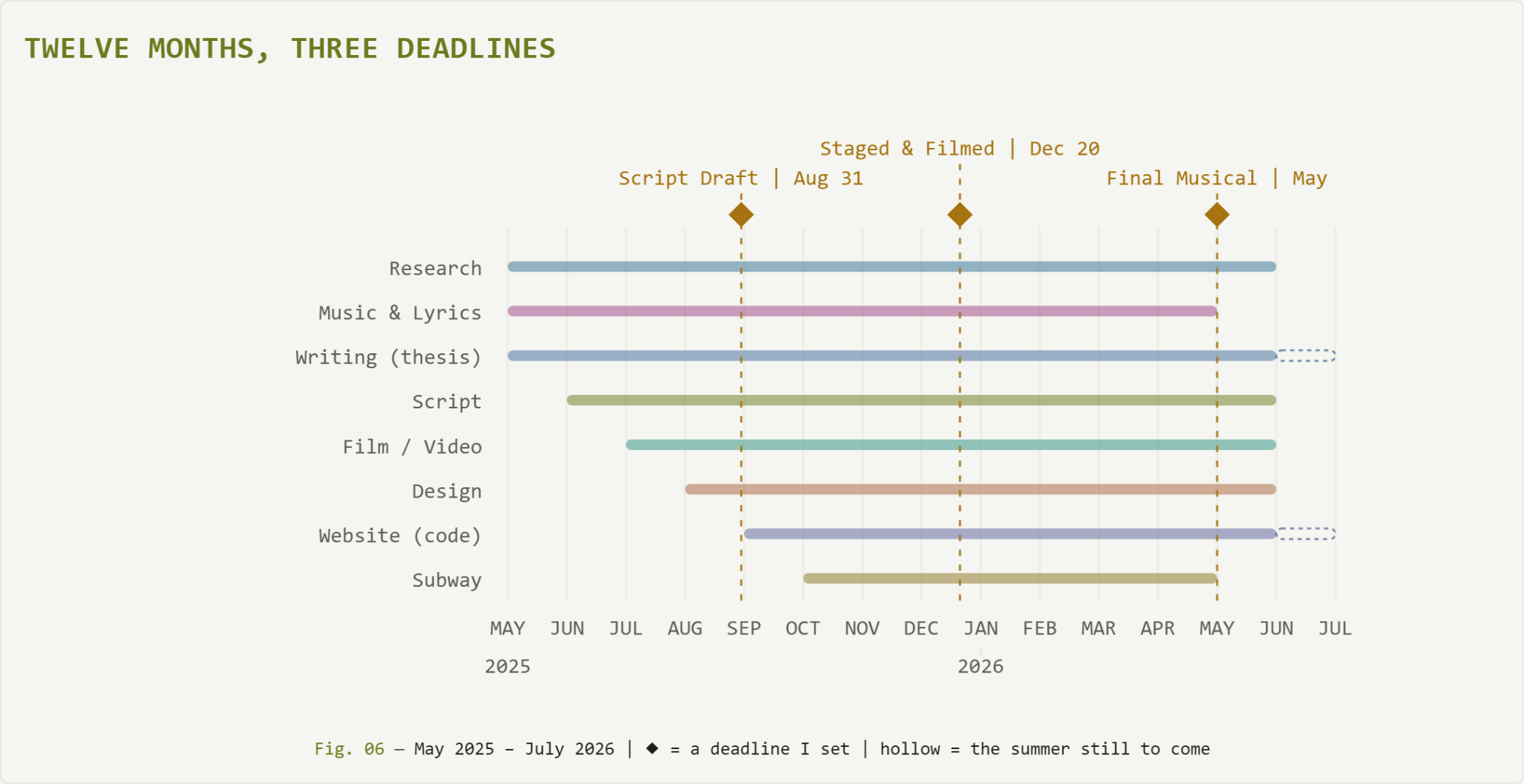
Figure 5 shows the entire timeline of this project, from May '25 to June '26. I made the original plan without AI; it had been percolating for months while I worked out how I could make this possible. In May, I knew I had until the following summer, so I set the musical to be finished by May '26 — exactly a year.
That left June and July to analyze the data, write the thesis, and finish the web app where everything would live. My first deadline was a first draft of the script by August 31st, the start of MIT's fall semester. My second was a fully staged and filmed draft by December 20th, just in time for winter break. These were my constraints, and I needed every moment.
As mentioned in Chapter 00, while creating this work, I kept track of all my conversations with the latest LLMs. The purpose of this was to document where and when AI was most useful throughout the creative process. To make it easy to track when I used AI, I only used one of the major LLM platforms: Anthropic's Claude models. I chose Anthropic because Claude had, at the time, the strongest reputation among the writers I knew for prose and long-form work. That was a perception, not a benchmark result. It also had a privacy policy at the time that did not train new models on users' data, which I felt would keep my intellectual property safe. That changed partway through this project: in August '25, Anthropic updated its consumer terms so that conversations would be used for training unless a user opted out, and extended data retention from thirty days to five years (“Updates to Consumer Terms and Privacy Policy” 2025).
Stanford's AI Index reported that within a single year the gap between the top-ranked and tenth-ranked models on Chatbot Arena fell from 11.9% to 5.4%, with the top two separated by 0.7% (“The 2025 AI Index Report | Stanford HAI” 2025). The best LLMs were close enough on benchmarks; choosing Claude over Gemini, ChatGPT, or Grok, etc, didn’t yield any significant advantage, so I estimated that using Claude every day would be analogous to using any other top-tier model of my time. If there were an open-source model comparable to these top-tier LLMs that I could run fast enough on my local machine, I would have chosen it for privacy and safety reasons.
AI Tools for Augmenting Creativity
There are truly countless tailored AI tools across domains designed to enhance traditional creative workflows. There are both commercial tools and bespoke systems built for academic studies. Since my practice spanned scriptwriting, music, code, and visual media, I surveyed tools in each area to determine what was useful to me and how they related to my research.
What struck me across this landscape is that nearly every tool is single-domain, and nearly every study of them examines a single task. There are few accounts of an artist coordinating these tools across an entire multi-domain production, deciding, layer by layer, what to automate and what to protect. That coordination problem, more than any individual tool, is what this thesis documents.
Scriptwriting systems such as ScriptBook (Zerman and Founder n.d.) and CharacterMeet (Qin et al. 2024) assist with narrative development, and commercial tools like Sudowrite (“Sudowrite - Best AI Writing Partner for Fiction” n.d.) target prose fiction. They all insert automation differently into the generation, feedback, and iteration phases of a co-creative loop. The most relevant academic precedent to mine is DeepMind's Dramatron (Mirowski et al. 2023), a hierarchical script co-writing system evaluated with professional theatre and film professionals. It examines writers using a purpose-built system over multiple sessions, but the system relies on extreme automation, writing an entire story from a single log line. My approach was to integrate a general-purpose model over the course of a year and clarify when I felt AI was helpful and when it wasn't, as an aspiring screenwriter and filmmaker.
For Music, generative platforms such as Suno (“Suno | AI Music Generator” n.d.) and Udio (“Udio | AI Music Generator - Official Website” n.d.) can produce complete songs, including lyrics, vocals, and backing tracks from a single text prompt. When I began in 2025, these platforms didn’t offer detailed control over what they could generate, but served you a single audio file as an output. They have since transitioned to developing their own editing pipelines that more closely resemble those of traditional DAWs (digital audio workstations), such as Ableton Live, Apple Logic Pro, Avid Pro Tools, and FL Studio.
Google's Magenta Realtime2 (“Magenta” n.d.) is a suite of tools built around its real-time models for controlling generation with a variety of signals such as MIDI, text, and audio files. These more sophisticated control mechanisms hadn’t been released when I began this project, although it was clear this was the direction all companies were headed. Artists themselves have also built their own systems, such as Holly Herndon's Holly+ (“Holly+” n.d.), which points toward a different path in which a musician constructs their own instrument using their own data and machine learning.
Since I had never made music before starting this work, I did not use generative audio models in my creative process. Instead, I relied on LLMs to teach me how to make music more traditionally, as discussed in Chap. 02. This approach, I determined, as an untrained musician, was a necessary precursor to using these generative audio systems, which typically operate at a high level of abstraction, asking users to create music using language. Since I had no foundational knowledge, I didn't know where to begin with these tools.
For Code, assistants such as GitHub Copilot (“GitHub Copilot · Your AI pair programmer” 2026), Cursor (“Cursor: AI coding agent” n.d.), and Claude Code (“Claude Code by Anthropic | AI Coding Agent, Terminal, IDE” n.d.) have made natural language a viable programming interface, the foundation of the "vibe coding" practice I document in Chapter 03. These tools dramatically improved in their capabilities over the course of this project. As a result, the fields of back-end development, front-end development, UX/UI design, and product management are collapsing into a single workflow. There are only a few studies interrogating how the creativity of code has changed due to these massive improvements. This case study offers a glimpse into new agent-based workflows and how jobs will be redefined in response to the advantages and disadvantages of using AI to build complex software.
Visual media models — images, video, and world models — have also improved drastically in a single year. Tools such as RunwayML (“Runway | Building Real-World Intelligence” n.d.), Stability AI (“Stable Video” n.d.), ComfyUI (“Comfy - Professional Control of Visual AI” n.d.), Seedance (Gao et al. 2025), and Genie 3 (“Genie 3: A new frontier for world models — Google DeepMind” 2025) create images, videos, 3D assets, and virtual gaming environments through simple text or 2D image prompts. We have unlocked the ability to make a virtual asset of nearly anything we can imagine, instantly. Which turns out to be its own problem: creative freedom without any bounds.
Visual media models were used minimally in my projects due to the still-persistent “uncanny valley effect,” the eerily unnatural quality models can produce when depicting humans and movement. Of course, these imperfections will likely be corrected for future creatives. However, as I defined my aesthetic world, primarily using live-action film of me acting and dancing, integrating generative visual media often cheapened the overall style, as described more in chap. 05. Therefore, visual models were only useful for branding and publishing.
Low Tech Tools for Augmenting Creativity
Forcing myself to make quick decisions under this tight project deadline, I imposed rigid creative constraints. Creative constraints are boundaries, rules, or limits applied during a creative process that narrow your set of choices. This is useful because when confronted with a blank page, it's difficult to know where to start, which can be overwhelming. Many artists impose constraints on their process and even build tools that enforce rules on themselves, breaking themselves out of writer's block or habitual ways of working.
Musician and producer Brian Eno's Oblique Strategies, made with the painter Peter Schmidt, is one of the most famous examples (“Brian Eno-Oblique Strategies” 1975). Each card in the deck carries a rule to follow when making a new piece of music, and Eno used it with groups of musicians to provoke sonic qualities they wouldn't have reached on their own. Composer John Cage used a stricter method: chance operations. To compose Music of Changes, Cage tossed three coins six times and read the result against the I Ching, using it to select among charts of sounds, durations, and dynamics he had built in advance (Pritchett, James 1993). Rather than Cage being a creator with complete authorship, chance became a tool he delegated creative choices to.
The Co-Creative Principles I’ve developed during this process can be seen as a set of creative constraints when working with AI. One additional constraint I imposed on myself was that my script would be a one-person show, with me as the main character. This constraint was set to make it easier for me to rapidly rehearse and set the work without having to cast additional actors. But it isn’t exactly a one-person show.
I also use Jibo, the social robot, as a supporting character. Jibo was built by Jibo, Inc., a company founded by Cynthia Breazeal out of the Media Lab's Personal Robots Group (“Group Overview ‹ Personal Robots” n.d.). Conveniently, they were a neighboring lab to mine in the Opera of the Future group on the 4th floor of the Media Lab. Jibo’s research platform lead, Jon Ferguson, kindly set me up with just enough tooling to control the robot and puppeteer it to my script.
Additionally, everything was to be shot on a living room set I constructed in my limited lab space. Since I didn't have any budget to rent a space or build a set, I used my apartment furniture and designed a set in the lab that was convincing enough for the story. It consisted of merely a tan sofa, a black-and-white striped rug, 2 lamps, a large white desk, a desktop computer, a large monitor, and a speaker system (Img. 4). These creative constraints were my analog way of augmenting creativity before even touching a computer.
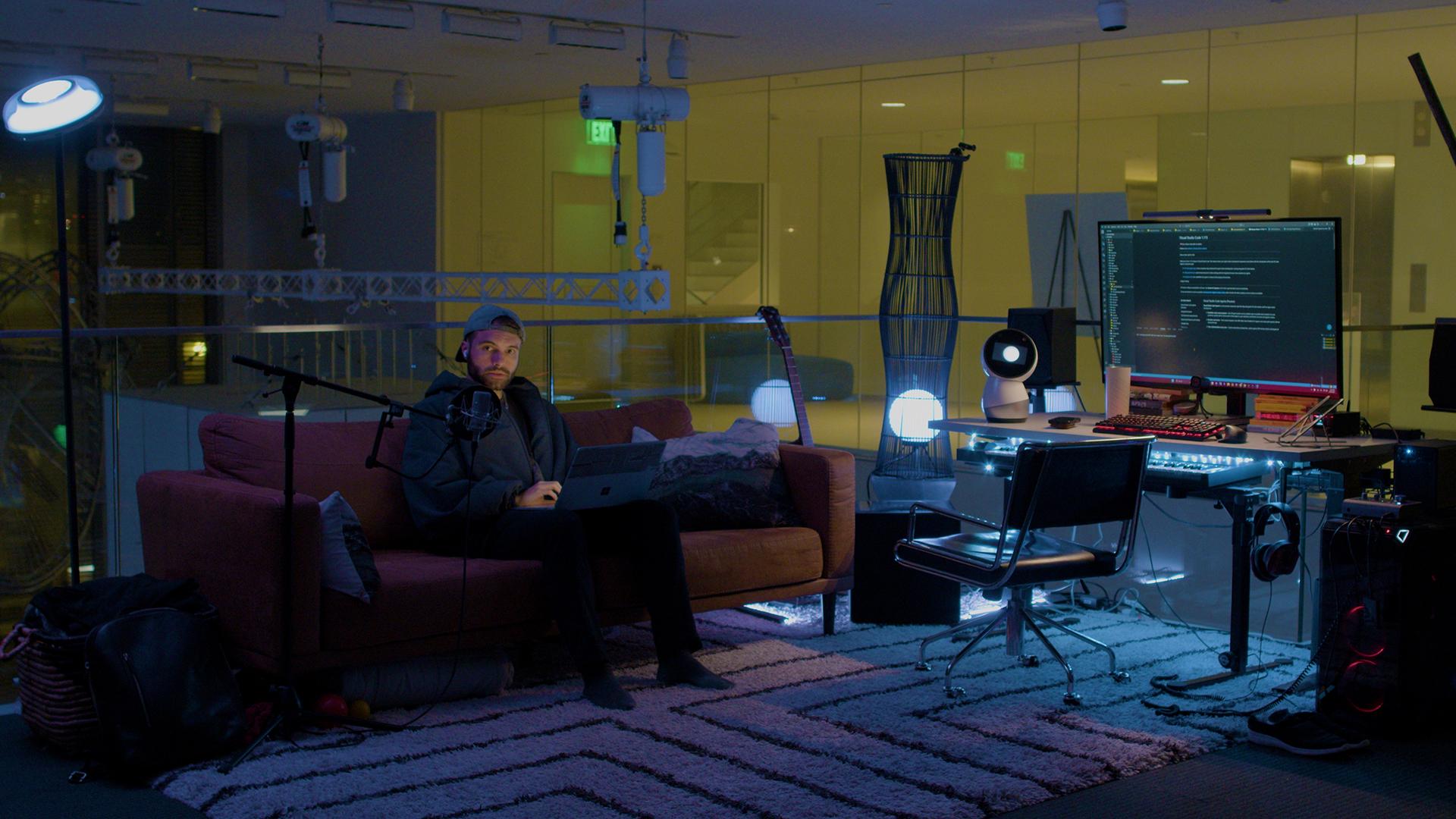
The story highlights the experience of an unemployed software engineer named Theos. This subject matter enabled me to document our current tech culture that I felt compelled to address. It was also a role I knew intimately, as a software engineer myself, in a community of engineers at MIT, which gave me the confidence to write and act the character with integrity.
The Jibo robot, named CLEO in the story, was written as Theos's sister. I have a sister of my own, so the dynamic came naturally. Pushing the human-AI relationship past the romantic was a deliberate choice. Rather than reinforcing the sexualized depiction of AI companions, such as in the popular film Her (Jonze, Spike 2013), where the main character develops a romantic relationship with his, I thought a sibling was closer to how I actually relate to these tools. Theos, an unemployed software engineer, and CLEO, his robot sister, trapped in a minimal San Francisco living room, were my constraints for making this musical.
Sci-Fi Operas, Films, and Musicals
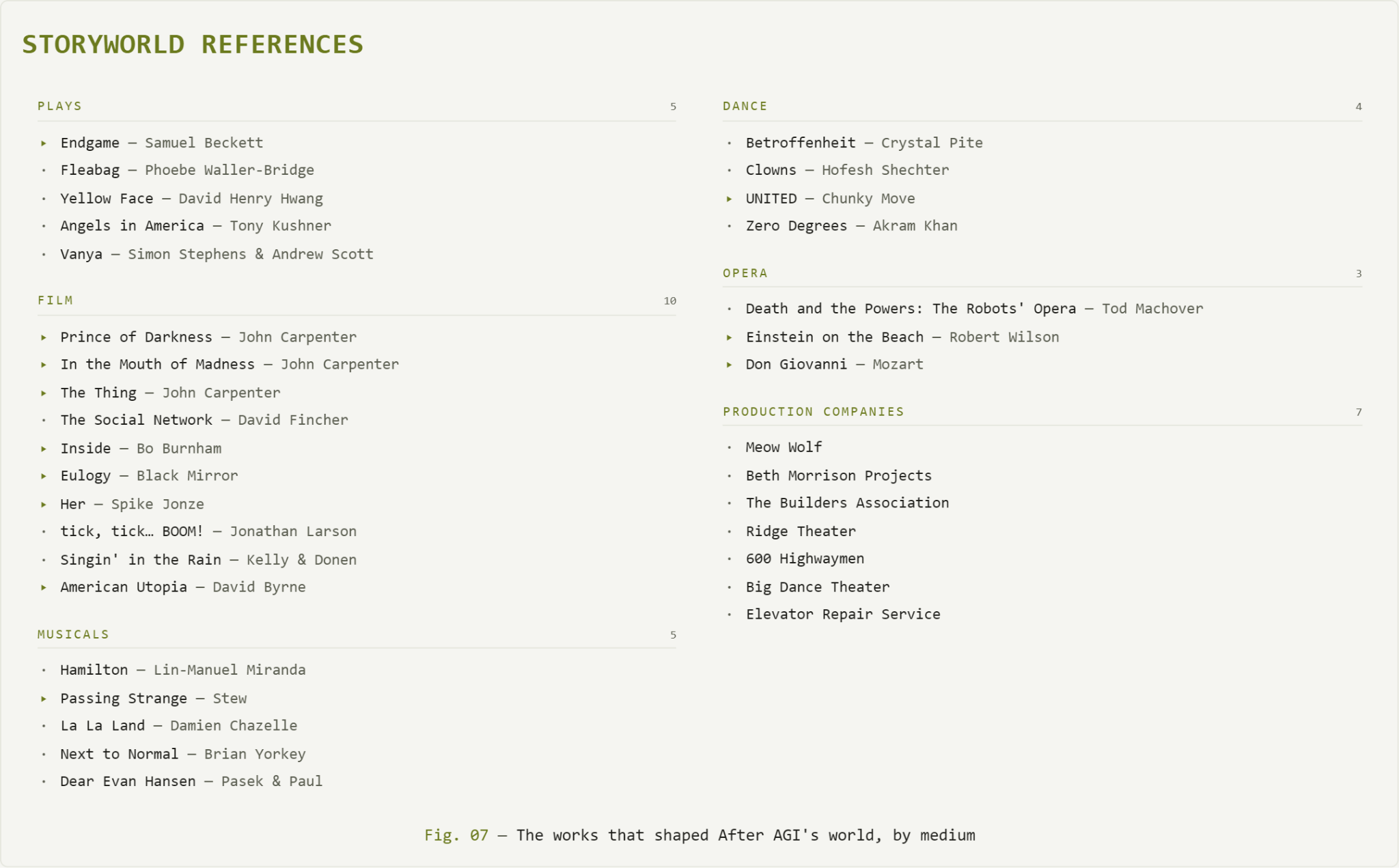
Sci-fi in musical theatre remains a rare but emerging form. In making this one-person science fiction musical, I studied a long list of works to guide my style and aesthetic language, including performances, films, and scripts, all of which are shown in Figure 6.
Tod Machover, my lab's Principal Investigator, is a pioneer in bridging technology and live performance. At the Media Lab, he developed Death and the Powers (Machover, Tod 2010), which integrates robotic performers and interactive technology into operatic storytelling, and pushed the boundaries of live sound through a blend of traditional and digital instruments. It establishes a precedent for technology as both subject matter and instrument. With a robot as a main character in my own performance, it set an example of how minimal robotic behavior can carry sci-fi worldbuilding.
More recently, Maybe Happy Ending (Aronson, Will and Park, Hue 2024), which won the 2025 Tony Award for Best Musical, told the story of two obsolete robots who fall in love, both played by human actors. Its plot was science fiction, but its score was traditional musical theatre, which I thought was a mistake. Hamilton (Lin-Manuel Miranda 2015), which won Best Musical in 2016, had brought a contemporary hip-hop aesthetic to that same traditional musical theatre form. Between them I found the confidence to build rich storytelling from only two characters, and to challenge the showtune idiom by putting techno music inside my sci-fi narrative.
An older work that gave me the same permission was Samuel Beckett's Endgame (Beckett, Samuel 1958). Its apocalyptic setting, two primary characters, and single confined room mirrored many of my constraints. Since Endgame is a lesser-known reference, my default one-liner became "imagine a Black Mirror episode as a musical". This referenced Charlie Brooker's dystopian anthology, made originally for Channel 4 in 2011, which increased in popularity after being produced by Netflix in 2016 (“Black Mirror” 2011).
Two other key references for me were Bo Burnham's special Inside (Bo Burnham 2021) and Phoebe Waller-Bridge's original play Fleabag (Waller-Bridge, Phoebe 2013). One-person films are rare; one-person plays have a long history. These are primary examples of each. From them, I decided I could make a special-length work that borrowed the form of the solo stand-up special (like Inside) but used the structure of theatre (like Fleabag).
Without any budget to hire professional lighting, stage management, or a film crew, I was also the cinematographer. I relied on cutting between a single wide shot and periodic close-ups, a technique often used in filming live performances. Inside had an intelligent combination of music and film techniques that I leaned on while editing and shooting this work. Fleabag, the play, used voice-over tracks to give presence to disembodied character voices during the one-woman show, a useful technique for extending the scriptwriting beyond monologue.
Across all of these references, there was a gap: a truly one-person musical with a narrative structure. I’m still taken aback by how rarely musical theatre uses futuristic storytelling, or applies the contemporary sonic qualities common to popular genres like hyperpop. That gap was both an opportunity and a reason to lure this traditional form into the present.
The lived experience of technologists navigating AI displacement, which had yet to be expressed artistically in musical theater, seemed like the obvious subject matter to tie this work together. In this moment of tech backlash, an engineer grappling with his guilt over contributing to a cultural upheaval through music had both the story and form I cared about, which became the central narrative focus of After AGI.
P1: Begin with the AI Last Approach
Looking at my blank Google Doc, I knew the first draft of the After AGI script wouldn’t be perfect, but I needed it quickly. My timeline gave me 3 months. Surprisingly, I finished Draft_01 in 2 months. It had 14 scenes, each averaging 2-3 pages, with placeholders for musical numbers. It was far from finished, but it sketched a story arc, and getting that down on paper was a relief.
Draft_01 had two disembodied supporting characters that never made the final version. Not a single line from it survived. At the time, I had no idea how much would stay unseen in my Google Drive. And only later did I understand why that mattered, which leads to my first Co-Creative Principle: Begin with the AI Last Approach.
From the beginning, I decided not to use AI at all for assisting with the first draft of the script. Once I had a first draft, I told myself I could use AI for feedback after a strong foundation was in place. This principle, called Begin with the A.I. Last Approach, originally emerged as retaliation against “AI-First” tools such as Dramatron (Mirowski et al. 2023), and other commercial systems that generate an entire script for you from just one logline. But to be clear, when I say AI last, I don’t mean no AI at all. The idea is simply: if you don’t need it, don’t use it! I promise you don’t always need it, and rather than reaching for assistance from the start, this approach will give you an immense sense of ownership you won't otherwise have.
The story about an unemployed software engineer and his AI companion was very close to my personal experience, so I didn’t need AI to write a first draft. Although it was short and incomplete, it contained my personal ideas. And even though I rewrote the entire script, I periodically returned to the original version as I made iterations.
This quick-and-dirty version served as a useful foundation for grounding what I cared about in these characters. It helped me understand what I found intriguing about the world. The primary conflict, the challenges the main character would face, and how they would inevitably evolve by overcoming them were all encapsulated in this draft. Just not in the right form yet.
You may not feel capable of writing an entire draft from scratch. But this principle has roots in the old "write what you know" maxim: if you have an idea for a story, write down everything you already know about it first. And if you do need AI help at the start, have it ask you questions. Make it provide questions about a character, a subject, a setting, and write down whatever comes back that interests you.
Generally, before asking A.I. for ideas, pause and ask yourself whether you need help just yet. A.I. will undoubtedly give you a lot of ideas, but they might not be good ones, even if they seem like it at first glance. Good ideas are usually personal ones, because subjects you care about are the ones you'll give the respect and detail they deserve. The risk is that once you get AI’s thoughts in your head, it's hard to get them out, and they will influence your own.
P2: Your Wrong Answer is Better than AI’s Right Answer
There were many things wrong with this first draft of the script. Specifically, it had too many moving parts for me to pull off realistically. For example, in this first draft, one main storyline was that the most advanced AGI model was running an experiment on the human population, tasking them with caring for a synthetic child. This plotline was interesting, but I determined I couldn't pull it off within my constraints.
AI models often default to tropes, or to generic combinations of past work. When I began, they were also worse at generating compelling prose. But even if a model can write better than you, my next principle holds: Your Wrong Answer is Better than AI's Right Answer. The crux is that mistakes and vulnerability lead to the most original ideas.
At one point, AI would continually “hallucinate” false information, such as suggesting titles for references that never existed, or inventing credentials for a person that are untrue. Today, these tools are increasingly trained to avoid hallucinations. This is great for research but not for generating original ideas. It is also increasingly guard-railed for safety reasons, some questionable and some legitimate, to avoid subjects such as suicide, biohazards, and political polarization. Due to suicide and depression being main elements in this story, AI did avoid giving me direct feedback, but only once.
Plot points specific to a community need personal, often vulnerable details. Gripping stories often address polemical topics and feature characters with highly flawed personalities. AI is becoming less capable of producing these rich human experiences due to growing constraints, and it often requires careful guidance to capture nuanced details. So the more direct process is to generate a world yourself, using specific characters, settings, and plot developments that you can flesh out without resorting to artificial support.
It's easy to be tempted to ask AI for help. Even if what it produces is generic, the answers it provides often seem right. Articulated well, they can be convincing even if the ideas are not compelling. Ultimately, what you enable when you let yourself generate “wrong” answers is self-awareness about what you actually know. Identifying your strengths and weaknesses in writing helps you gain a deep understanding of what comes naturally, what habits you fall into, and where you need to improve. Without seeing your work for what it truly is and instead relying on AI-generated outputs, you lack awareness of what your novel contributions could be. Thankfully, in May ‘25, AI writing was so easily identifiable that it forced me to take this approach.
From Draft 01 — Draft 17
AI was most helpful during the feedback and iteration phases of my scriptwriting. But once the first draft was done, the script stopped being my priority, and I pivoted to the music. That forced a break, and I came back to it months later with one question at the front of my mind: how was I actually going to shoot this?
By this point I was essentially living in my set on the 4th floor of the Media Lab, working day and night, going home only to crash for a couple of hours before starting again. My dorm, building E2, was at 70 Amherst St, literally across the street. Which meant I was now comfortable with where the musical was headed. Writing Draft_02 took even less time, just the month of November. This draft was the real skeleton that I kept revising until Draft_17.
Voice Notes were one of the main additions to this draft—an example of a Voice Note is linked below Video 02. I came up with them to solve two problems. First, Draft_01 was totally linear, and it desperately needed something to break it up. Second, since I intended to perform this live, prerecorded elements between musical numbers were necessary to give me chances to rest. To do this, I wrote them as flashback monologues in which Theos addresses his virtual therapist, Rebecca. Seven of them are placed across the script.
Writing these monologues came easily, and I enjoyed them. Unexpectedly, they were what solidified Theos's voice and personality. Between Draft_02 and Draft_17, I used AI for direct help almost not at all. What I used most was a browser text-to-speech extension so I could listen back to the script each time I made changes. That alone was enough for me to decide if the characters' language and style were what I intended. Mostly the difference between script versions was cutting scenes or songs altogether. I might have used AI more had I had more time, but by Draft_02 the script was far from the weak link. With six months to my premiere, I was still only just learning how to listen to music, let alone make it.